3rsblog

  • Subscribe to our RSS feed.
  • Twitter
  • StumbleUpon
  • Reddit
  • Facebook
  • Digg
Se afișează postările cu eticheta pop culture: TV. Afișați toate postările

marți, 25 februarie 2014

A Fan(girl)'s Notes: (Untimely) Thoughts on SHERLOCK, Series 3

Posted on 08:00 by Guy

(NOTE: I will make NO attempts to avoid possible spoilers for any previous season of Sherlock in the following discussion. If you're a spoilerphobe, please feel free to slip out now!)

(NOTE: This has been edited and republished to include some observations I inadvertently left out of the original post, and which have no impact on the preceding spoiler-policy disclaimer.)

We've become used to intervals of two or three years between installments in movie series, but with rare exceptions--there was that eighteen-month gap between the fourth and fifth seasons of Mad Men--we don't experience that sort of thing so much with television. And when a television series ends a season with a thoroughly mind-bending cliffhanger before it goes on that two-year break, we have lots of time to speculate and discuss what we think happened, and what we think will happen when it comes back. Our expectations may get just a little bit out of hand.

SHERLOCK via Masterpiece PBS
(via PBS.org: MASTERPIECE: Sherlock, Season 3)
Sherlock's return for its third season (or "series" in the original BBC language) was met with all the expectations that built up over its long absence among an audience that grew substantially (thanks to DVD, Netflix, and Hulu, not to mention Tumblr) while it was away. There was no way it was going to satisfy all of them.

Discussing the most recent three-episode season on the Firewall & Iceberg Podcast, Dan Fienberg commented,
"The writers manage to make the writing clever even if the plotting isn't clever. I felt like there was a lot of people trying to write witty dialogue and using witty dialogue to cover up for bad structure and bad plotting. And if you were willing to just sit back and go 'OK, I am enjoying watching these characters be smart and sparkling,' that's fine."
I was 99.5% willing to do exactly that. Series 3 of Sherlock seemed to be less warmly received by critics and professional TV viewers than its first two outings, but complaints from the general fandom were rare. And Series 3 clearly reflected an awareness of that fandom, along with an increased awareness of the show's own self-image. This could be off-putting to viewers who don't care for insider-y meta references; I'm not one of those viewers, and that was part of why I so thoroughly enjoyed this season.

That said, I will mention a few minor issues...

It may have been more apparent this season than it was during its first two--to people who watch both shows, at least--that Sherlock and Doctor Who have the same showrunner, Steven Moffat. Feinberg's observation--I'm not certain that it's a complaint, really--sounds like it could have been made about any number of episodes from the Eleventh Doctor/Moffat era. (In my observation, it usually is a complaint when it's said about Doctor Who.) I felt that the show was more fun to watch than ever, but on reflection, I'm not sure it hangs together quite as well as prior seasons.

Some of that is due to an overall plot problem--namely, this season's lack of a strong master villain. Series 2 was so well framed by the Sherlock/Moriarty conflict that the follow-up probably couldn't help but feel a little weak by comparison. The mysteries themselves just didn't seem as compelling.

And one of the previous season's mysteries still essentially remains one--we still don't know how Sherlock faked his death at the end of Series 2. The Series 3 premiere offered several possibilities, but never committed to any of them--and I actually thought that was a brilliant approach. As I said earlier, this season felt like it was made for the fans; this episode dramatized several very popular fan theories without ever answering the question...and any definite answer would have made some subgroup of fans unhappy, so entertaining many without aligning with any was a smart, if slippery, decision by co-creators Moffat and Mark Gatiss.

But if the stories seemed weaker, the character interactions and development were difficult to fault--and they're the main reason I love Sherlock. (Well, that and being a card-carrying Cumberbunny--h/t to Jennifer for the terminology!) As my husband has commented, the brilliant high-functioning sociopath Sherlock Holmes would be thoroughly unbearable real-life company, but as portrayed by (the glorious) Benedict Cumberbatch, Sherlock does seem to be developing a surprising degree of self-awareness of what a mess he really is; my favorite example was his assurance to the newlywed John and Mary Watson that they would be great parents, because they'd gotten plenty of experience with babies thanks to dealing with him. (Any degree of self-awareness from Sherlock is surprising, frankly.) In the absence of a "big bad" to engage Sherlock this season, there was more focus on Dr. John Watson and his relationships with his best friend and new wife, giving Martin Freeman plenty to do with the role--and he did it terrifically well.

I think I appreciated some of Sherlock's technical aspects more this most recent season than I have before. I've always liked the music (I'm looking for ringtones based on it, actually), but I was particularly struck by the cinematography and editing this time around. I enjoy looking at this show, and I think it has a very particular, and appealing, visual sensibility (which I should note seemed to display fewer onscreen text messages than it has previously). (This is apart from the previously-mentioned appeal of looking at Mr. Cumberbatch.)

My only remaining quibble with this show is that, imperfections and all, a three-episode season is just not enough Sherlock. It was all over too quickly, and I just hope we won't have to wait quite so long to see these characters again!

********************

sherlocked official convention massive events

The game is on--the first official Sherlock fan conventions are being planned in the US and Europe later this year. That's all the info currently available, but if you think you'd be at all interested in this, you might want to sign up for the sherlocked.com mailing list sooner rather than later. I've already done so.
Read More
Posted in 'riting, pop culture: TV, thinking out loud | No comments

miercuri, 19 februarie 2014

WW: Black & White & A Little (TARDIS) Blue

Posted on 05:00 by Guy
Paul and I spent Valentine's weekend sharing the love of Doctor Who with fellow fans and friends (and a few stars) of the show at the annual Gallifrey One convention here in Los Angeles. Saturday was our "cosplay day." 

Florinda Paul TARDIS GallifreyOne 2014

Disclosure: I made edits to comply with this week's Wordless Wednesday theme, "Black and White," but since this 50-year-old TV show was in black-and-white when it started, I think they're appropriate.


An InLinkz Link-up
Read More
Posted in fotos, pop culture: TV, randomness, Wordless Wednesday | No comments

joi, 12 decembrie 2013

Book Talk: I WANT MY MTV, by Rob Tannenbaum and Craig Marks

Posted on 05:00 by Guy
I WANT MY MTV via indiebounddotorg
I Want My MTV: The Uncensored Story of the Music Video Revolution
Rob Tannenbaum and Craig Marks
Penguin Plume (2012), trade paper (ISBN 0452298563 / 9780452298569)
Nonfiction: pop culture (oral history), 592 pages
Source: Purchased ebook (iBooks ISBN 9781101562415)
Reason for reading: Personal

The popular music of my lifetime is divided, in my mind, between “before MTV” and “after MTV.” I first saw Music Television in the fall of 1982--my boyfriend’s family had cable--and was fascinated by the channel and the new music it showcased. I lost track of it for a few years--the boyfriend became a husband, we became parents, and we didn’t have cable--and when I caught back up with it again, we had both changed. MTV came to define the 1980s...but in reading about its first decade in the oral history I Want My MTV, it occurred to me, and not for the first time, that its 1980s weren’t exactly my 1980s.


The 1980s are sometimes dismissed as an era when style trumped substance, and MTV and its influence are a big part of why it has that reputation. In its early years, MTV was radio with an enormous potential reach, and as the book notes, it reached audiences that hadn’t had the chance to be exposed to cutting-edge popular culture--many smaller, more isolated markets had cable television well before the big coastal cities did. (MTV was produced in New York City, but it actually wasn’t available for New Yorkers to watch it for a while.) But the “television” part of Music Television was what made the difference--the channel’s reach was amplified by the visual images that accompanied the music, and presented us with style and attitude that soon seeped into the mainstream.


I Want My MTV delivers on the style and attitude. I thought it resembled the channel’s early, all-music-video years in the way it kept me reading, eager to see what would come along next--but it also mimicked the exhaustion that would set in after watching MTV for hours, seeing some videos half a dozen times while the ones you were waiting to see never turned up at all. The book includes quotes from hundreds of people who were involved with MTV during its first decade in both its business and creative operations, and result is rarely dull, but it’s often scattered and not particularly insightful. It’s not at all difficult to imagine a multi-part TV documentary based on this--the talking-head clips are already here, and there’s certainly plenty of suitable video footage to edit in among them.


I might watch that documentary, to be honest, and I’d probably find it more satisfying than the book. I really did hope for more substance from I Want My MTV, and maybe that was my mistake. Maybe those years I lost touch with MTV are part of it too; I missed much of the channel’s transition from “modern rock” to “hair metal,” so I was less interested in the behind-the-scenes dirt on many of the videos discussed in the book. Don’t get me wrong--it was fun to read all the insider stories here, but I find that I don’t really need to hear as many tales of excess and decadence as I Want My MTV offers. I think MTV’s influence on late-20th-century popular culture is undeniable, but I think I’d like to read a history of it that’s a little more analytical and a little less personal.

Rating: 3.25 of 5

Book description, from the publisher’s website:
It was a pretty radical idea-a channel for teenagers, showing nothing but music videos. It was such a radical idea that almost no one thought it would actually succeed, much less become a force in the worlds of music, television, film, fashion, sports, and even politics. But it did work. MTV became more than anyone had ever imagined. 
I Want My MTV tells the story of the first decade of MTV, the golden era when MTV's programming was all videos, all the time, and kids watched religiously to see their favorite bands, learn about new music, and have something to talk about at parties. From its start in 1981 with a small cache of videos by mostly unknown British new wave acts to the launch of the reality-television craze with The Real World in 1992, MTV grew into a tastemaker, a career maker, and a mammoth business.

Featuring interviews with nearly four hundred artists, directors, VJs, and television and music executives, I Want My MTV is a testament to the channel that changed popular culture forever.

From the Introduction:
“Hardly anyone thought it would succeed.

“Upon hearing of the plan to launch a TV channel that would show music videos around the clock, businessmen of wealth and experience--wealthy men who ran record companies and partied with rock stars, and visionary men who made fortunes by anticipating the explosion of cable TV--scoffed and snickered. Who would watch this channel? Even if it proved popular, who would advertise there? Why would FM or Anheuser-Busch want to reach this channel’s audience, consisting mostly of fourteen- to twenty-four-year-olds? Where’s the money in that?

“Prior to the launch of this channel on August 1, 1981, only a few dozen people believed it would succeed, and all of them worked at the channel. The start-up staff was a coterie of misfits, inexperienced and determined, and included two one-eyed executives who were later hailed as visionaries. Which is not to say everyone who worked at the channel believed it would succeed. ‘It sounded like an asinine idea,’ Bob Pittman (one of the one-eyed executives) admitted five years after the launch, when the channel was the centerpiece of a $525-million bidding war. It’s easy to imagine this as the theme of one of the network’s early advertising campaigns, which were usually brash and self-mocking: ‘MTV: It sounds like an asinine idea.’”


Shop Indie Bookstores Affiliate Marketing Links
Read More
Posted in Ebook Reading Challenge, nonfiction, pop culture: music, pop culture: TV, reading, reviews | No comments

vineri, 29 noiembrie 2013

Playing With The Stars: Visiting the Hollywood Wax Museum

Posted on 06:00 by Guy

The original Hollywood Wax Museum has occupied a prime spot on the Hollywood Boulevard Walk of Fame, just east of Highland Avenue, for nearly fifty years, and is still owned and operated by the family who started it back in 1965. But this place is no dusty, stuffy relic of old-time show biz--visitors are encouraged to become part of the show here. Everything you’ll encounter is camera-ready, and you’re more than welcome to get in the picture.

Hollywood Wax Museum collage 3rsblogdotcom

Tall Paul and I began our recent visit to the Museum with that wax-museum staple, the Chamber of Horrors. This version focuses on monsters from the movies, of course, and is less interactive than other sections of the museum. This is where you’re more likely to take pictures of the figures than with them. I think that makes sense, though--really, how close do you really want to get to Dracula, or Frankenstein, or Hannibal Lecter? I’d just as soon keep my distance from Voldemort, thanks.

movie monsters 3rsblogdotcom

If you prefer to keep your distance from any and all monsters, you can
Red Carpet photo 3rsblogdotcom
Life size, on the Red Carpet
go straight to the Red Carpet, where you can mingle with A-listers like Brangelina, George Clooney, Morgan Freeman, and Nicole Kidman. Play paparazzi all you like here--it's all designed for family fun!


As you continue on, you’ll find a very eclectic mix of familiar faces in and out of character. You may see some of them more than once, in different roles--or maybe you won’t. The Museum’s collection represents nearly a century of entertainment, and is frequently rotated and updated based on visitor surveys. Therefore, you may not see the same figures on your visit that we did on ours, but you will see movies, TV, and music are all represented, and you’ll be able to get up close for photos of, and with, the stars.


wax figure details HWM 3rsblogdotcom
Details matter: Indy has stubble, and Jeannie has no navel
Each wax figure in the Museum is individually crafted, and so I wasn’t surprised to see that the degree of resemblance to their subjects varies quite a bit. Everyone’s recognizable, but some are remarkably accurate likenesses with an impressive level of detail--right down to Indiana Jones’ chin stubble, for example.

Vitameatavegamin 3rsblogdotcom
Of COURSE I love Lucy!
This tribute to popular culture and entertainment offers plenty of entertainment in itself. The Museum’s website invites you to “come play with the stars,” and that’s what we did. Tall Paul and I had a fun afternoon posing and playing and making jokes among the wax figures. Half the fun of taking photos in tourist attractions like the Hollywood Wax Museum is coming up with the captions you’ll give them when you post them on Facebook--or coming up with the captions and then composing the photos to go with them--right?

The Hollywood Wax Museum is located at 6767 Hollywood Boulevard in Los Angeles and is open daily (365 days a year) from 10 AM to midnight. Tickets are available online and at their box office. I received complimentary admission to the Museum to facilitate this post.

I was selected for this opportunity as a member of Clever Girls Collective and the content and opinions expressed here are all my own.
Read More
Posted in mostly true stories, pop culture: movies, pop culture: TV, randomness, So Cal | No comments

joi, 21 noiembrie 2013

A Fan(girl)'s Notes: DOCTOR WHO, Part 2 of 2--A Selected, Subjective "New Who" Episode Guide

Posted on 05:00 by Guy
I can’t play favorites with “classic” Doctor Who episodes, for reasons I’ve previously explained, but I certainly can with “new” Who, and I’m about to do just that. If you’ve never watched Doctor Who, these may be good ones to sample for a sense of the show as it is today. If you’re a Whovian of any era, I’m happy to discuss, defend, or debate my picks with you, and I’d love to have you share some of yours in the comments! But first, let me answer some non-episode-specific "What's your favorite...?" questions--

The Doctor, the Captain, and the TARDISGal www.3rsblog.com
Playing favorites with Captain Jack and the Tenth Doctor at WonderCon 2013
  • Doctor: Ten (I may have mentioned that already, too)
  • Companion: Donna Noble. Her character arc allows her a lot of growth as it moves toward a heartbreaking end, and I love the bantering, bickering interplay between her and Ten.
  • Companion, Runner-up: Rory "Centurion" Williams. Who can resist a guy who waits two thousand years for the girl he loves?
  • Companion, Special Mention: Captain Jack Harkness, immortal action hero (and you can define "action" any way you like). Who can resist this guy, period?
  • Monsters: The Weeping Angels
  • Episode to watch over and over if I could only watch one: “Doomsday” 

Who's Who and What's What: A Selective and Highly Biased Episode Guide

The Ninth Doctor (Christopher Eccleston, 2005)
Primary traveling companion: Rose Tyler (Bille Piper)
The Ninth Doctor bbamerica.com

The “new” Doctor took some time to find the tone of both the show and its title character. The ninth incarnation of the character invites 19-year-old London shopgirl Rose Tyler along as a traveling companion--the Doctor has “companions” now, not “assistants”--but seems to blow hot and cold about humans as a species. That may be because he's coming to terms with being the last survivor of his own species, the Time Lords of the planet Gallifrey, after the devastating Time War with the Daleks.

To Be Watched

"The Empty Child"/"The Doctor Dances" (Ep. 1-9/1-10), written by Steven Moffat: The Doctor and Rose are confronted by frightening blank-faced mutants in 1941 London. Future showrunner Steven Moffat introduces two of his trademarks in this two-parter: silently terrifying monsters, and the dashing, rarely-silent Time Agent Captain Jack Harkness.

"Dalek" (Ep. 1-6), written by Robert Shearman: This is the first episode to bring classic Who foils into the new series. It goes for the Doctor’s greatest enemies of all, the murderous robotic Daleks, and I think that looking to its history gives the show a sense of itself that its new episodes really haven’t displayed before this.


The Tenth Doctor (David Tennant, 2006-2009)
Primary traveling companions: Rose Tyler (Billie Piper, 2006), Martha Jones (Freema Agyeman, 2007), Donna Noble (Catherine Tate, 2008)

The Doctor and Donna www.bbcamerica.com

The Tenth Doctor still carries the burden of being the last Time Lord, but it doesn’t seem to weigh quite as heavily. He also has a much higher opinion of humans than the Ninth did, and perhaps that’s why he seems to have more emotional range and depth. He also has a lot of company during his time in the TARDIS--first Rose, then medical student Martha Jones, and finally “just a temp” Donna Noble--but he ends his travels alone. Ten may be the most romantic incarnation of the Doctor to date--not all fans have loved that about him, but I certainly have.

To Be Watched

"Blink" (Ep. 3-10), written by Steven Moffat: This is frequently cited as the Doctor Who episode for people who have never watched Doctor Who before, and although it’s actually relatively short on the Doctor himself, I’m not going to disagree. It’s an excellent stand-alone story with plenty of the show’s hallmarks--a suspenseful story told well, emotional weight, and a truly scary monster (the Weeping Angels)--but very little overt “mythology.” I don’t think it’s possible to watch just one episode of Doctor Who and be done with it, but if that’s what you have to do, you cannot go wrong with this one.

"Army of Ghosts"/"Doomsday" (Ep. 2-12/2-13), written by Russell T. Davies: This two-parter brings back another classic-Who enemy, the Cybermen, and allies them with the Daleks. If that sounds like bad news, it is--and it ends up tearing the Doctor and Rose apart. "Doomsday" is the episode that made me go “all in” with Doctor Who, and if you can watch the last five minutes of it without getting choked up, I will wonder if you are less human than the Doctor himself.

"Human Nature"/"The Family of Blood" (Ep. 3-8/3-9), written by Paul Cornell: The Doctor entrusts Martha with the fob-watch containing his Time Lord memories, and becomes human. Using his standard alias, John Smith, he takes a teaching job at a boarding school and falls in love with the school’s nurse, while mysterious aliens begin preying on the students. This two-parter was recently chosen as the second-best Doctor Who story in a BBC America "superfan" top-10 poll, and I’m inordinately fond of it.

"Silence in the Library"/"Forest of the Dead" (Ep. 4-8/4-9), written by Steven Moffat: This two-parter takes place in the biggest library in the universe, but there’s more than books in its collections. The Doctor almost loses Donna to the monsters that inhabit it, but he finds River Song. The adventurous, gun-slinging archaeologist--Indiana Jones with lots of curly blonde hair, or “hell in high heels”--will become a big part of the Eleventh Doctor’s story, but by saving her life here, the Tenth makes that possible.

"The End of Time," Parts One and Two, written by Russell T. Davies: The “specials” that conclude the era of the Tenth Doctor are full of references and characters from the show’s previous three seasons, in a story where the stakes are as high as they can possibly be. The whole thing does feel a bit overstuffed and indulgent at times, but I appreciate every last minute with my Doctor, and I find this a satisfying farewell.


The Eleventh Doctor (Matt Smith, 2010-2013)
Primary traveling companions; Amelia “Amy” Pond (Karen Gillan) and Rory Williams (Arthur Darvill, 2010-2012), Clara Oswald (Jenna Coleman, 2013--)
The Eleventh Doctor (Matt Smith) and Amy (Karen Gillan) bbcamerica.com

The Eleventh Doctor brings back a stronger sense of the Time Lord’s alien nature, and that seems to amplify both his aura of power and sense of fun. There’s a trio in the TARDIS for most of his cycle, as he is joined by the (eventually) married Amy and Rory--this makes for some interesting interpersonal dynamics as we see how his presence affects their relationship. After Amy and Rory leave, Eleven is joined by the mysterious, memorable Clara Oswald, who is expected to stick around for the imminent arrival of the Twelfth Doctor.

To Be Watched

"The Pandorica Opens"/"The Big Bang" (Ep. 5-12/5-13), written by Steven Moffat: This two-part finale to the fifth series features the return of River, the reunion of Amy and Rory, a prison, a wedding (one of my top-five moments of the entire run of Doctor Who), and the rebooting of the universe. Also, “fezzes are cool.” I just love these episodes, but they aren’t ones you can go into unprepared; at least half of this season leads to this.

"The Impossible Astronaut"/"Day of the Moon" (Ep. 6-1 /6-2), written by Steven Moffat: The Doctor, Amy, Rory, and River go to America in two different times. In 1969, they meet President Nixon and help ensure that Apollo 11 happens as planned while trying to learn the identity of a mystery girl in a space suit. In 2011, they will see the Doctor die. This two-parter opener sets out the primary story arc for the sixth series, which carries through the four consecutive episodes “The Rebel Flesh,” “The Almost People,” “A Good Man Goes to War,” and “Let’s Kill Hitler,” and concludes with “The Wedding of River Song.”

"The Name of the Doctor" (Ep. 7-14), written by Steven Moffat: The Doctor’s newest companion, Clara, has been a mystery to him all along. This episode solves that mystery--and opens plenty of other questions, as it sets the stage for the 50th-anniversary special.

HerUniverse TARDIS Skirt www.3rsblog.com
"Exploding TARDIS" print skirt
"Vincent and The Doctor" (ep. 5-10), written by Richard Curtis: This episode does not directly lead to anything else in the show's narrative arc. It’s mostly a stand-alone, but this moving story of the Doctor and Amy’s meeting with Vincent Van Gogh does introduce one of the iconic images of “new” Who, the exploding TARDIS. I own two different items of clothing that feature it.

"The Doctor’s Wife" (Ep. 6-4), written by Neil Gaiman: I submit this stand-alone episode exploring the Doctor’s relationship with the TARDIS as Exhibit A of Doctor Who as a writer’s show--Gaiman is a lifelong fan, and he so enjoyed writing for it that he did it again a year later.

Related Reading and References: 
The Doctor Who pages at TVTropes.org
BBC America: Doctor Who
BBC One: Doctor Who

(NOTE: It was brought to my attention that the last couple of pieces I did for my writing workshop referenced Doctor Who rather heavily, but didn’t make allowances for readers who might have no idea what those references meant. As the portion of the world that does get those references gears up to celebrate the Doctor’s 50th anniversary this week--as if a half-century means anything to a thousand-year-old Time Lord!--it seems like an appropriate occasion to address that. These posts are not sponsored by anything other than my own excessive enthusiasm for Doctor Who. Some photos via BBC America: Doctor Who at 50 and BBC One.)
Read More
Posted in 'riting, pop culture: TV | No comments

miercuri, 20 noiembrie 2013

Wordless Wednesday: Who's Who, Family Style

Posted on 05:00 by Guy
I managed to tie our Wordless Wednesday Linky Group prompt for this week, "Family," into my celebration of Doctor Who's 50th anniversary.

The Doctor & His Wife www.3rsblog.com
The Doctor and His Wife, Wondercon 2013

Read More
Posted in fotos, pop culture: TV, randomness, Wordless Wednesday | No comments

marți, 19 noiembrie 2013

A Fan(girl)'s Notes: DOCTOR WHO, Part 1 of 2--A Brief Personal History of Time (Lord)

Posted on 05:00 by Guy
Doctor Who Collectibles www.3rsblog.com
(NOTE: It was brought to my attention that the last couple of pieces I did for my writing workshop referenced Doctor Who rather heavily, but didn’t make allowances for readers who might have no idea what those references meant. As the portion of the world that does get those references gears up to celebrate the Doctor’s 50th anniversary this week--as if a half-century means anything to a thousand-year-old Time Lord!--it seems like an appropriate occasion to address that. These posts are not sponsored by anything other than my own excessive enthusiasm for Doctor Who. Some photos via the BBC Doctor Who Shop.)

One Saturday evening about three and a half years ago, I wandered into the family room to find my husband watching Doctor Who. I joined him on the sofa, and we were both intrigued by the story quickly (and just as quickly annoyed by BBC America’s inopportune commercial breaks). Both of us had some basic knowledge of the character and the premise, but neither of us had ever really spent much time watching the show before--I had attempted it during the early 1980s, when some PBS stations began importing the series from England, but couldn’t get past the cheap sets and cheaper special effects back then.

Those things are not obstacles with the more recent years of the series, but that’s only a small part of why we are now genuine “New Whovians,” fans who came to Doctor Who after the show was re-launched in 2005 and have seen every episode since then (thanks to a lot of binge viewing to make up for being a few years late).

Getting to Know Who


Given my devotion to the Doctor, you may be surprised to learn that I’m such a relative newbie. We came to Doctor Who near the end of Matt Smith’s first series as the Eleventh Doctor--we were captivated, but understandably confused. However, British TV seasons are relatively short (usually 12-14 episodes) and spaced months apart, so we’d have time to catch up on previous seasons on DVD before the next one began. But first we’d have to decide just how far “previous” we wanted to go--back five years, or twenty-five, or all the way? The show started back in 1963(!).

Dalek & TARDIS S&P shakers
We chose not to go all the way back to the beginning. We didn’t even go back to the “new” beginning right away--we started with the Tenth Doctor, David Tennant, figuring that would lead back into the place where we planned to pick up and continue. (We backtracked to the first “new Who” series, with Christopher Eccleston’s Ninth Doctor, just this year.) The transition from Ten to Eleven coincided with more changes in the show’s storytelling and visual feel than what ordinarily follows a recast, as the show-runner’s reins passed from Russell T. Davies to Steven Moffat at the same time, but even so, I think we made a good call.

BBC America has been running a monthly series of specials called “The Doctors Revisited” throughout 2013 in preparation for the show's 50th anniversary; each one focuses on a different Doctor and his era of the show, followed by one of his most significant stories. We watched all of the documentaries and nearly all of the featured episodes--we couldn't make it all the way through the Sixth Doctor story, but we liked most of the others, cheap sets and all. I understand more about where the show came from and how it developed now than I did a year ago, and I have more insight into how the new version honors the old. But I still don't feel any need to go further into the older shows--I'm fine with what I've already seen. I appreciate that Doctor Who has an extensive history, and I also appreciate that it’s accessible at nearly any point during that history.

The casting changes can be a good opportunity to get started with Doctor Who; whenever a new actor takes over the role, the show adjusts its footing and re-establishes itself a bit. That can offer the new viewer an easier way into its world--you may feel less like you’re walking into the middle of something. Most fans tend to have a special fondness for their first Doctor--whoever was in the role when they began watching--which is why many long-time American fans are still likely to claim Tom Baker’s Fourth Doctor as “theirs.” Maybe that attachment is even stronger when you and your Doctor start out together. (With the time of the Twelfth Doctor soon to begin, some new fans will have the chance to find that out for themselves.)

I don’t think that attachment should keep you from getting acquainted with the Doctors who came before yours, though, or make you hold back from those who come later. The beauty of the Doctor is that he is always the Doctor, in every form he takes, so it’s really okay to call more than one of them “yours.” My first Doctor, technically, is the Eleventh, but since we came into his first series three-fourths of the way through and we re-watched it all later, after we’d seen the full run of the Tenth Doctor, I count Ten as my first Doctor. And I can absolutely vouch for that special fondness for one’s first Doctor, even though mine was done being the Doctor by the time I got to know him. 

A Brief History of Who


The very first episode of Doctor Who aired on BBC One on November 23, 1963. The Doctor was a Time Lord from the planet Gallifrey who wandered across time and space with various “assistants”--mostly women, sometimes men, usually humans--in a vehicle called the TARDIS (an acronym for Time And Relative Dimension In Space), which was surprisingly roomy inside for something that appeared to be the size and shape of a phone booth from the outside. The serialized episodes blended science and historical fiction with thoroughly contemporary elements, and the show quickly became beloved by British audiences. The low-budget production values didn’t seem to prevent viewers from being drawn in by the well-crafted stories and engaging characters. From the beginning, Doctor Who emphasized the writing, and even today, an episode’s writer is the only person other than the stars to get a credit in the show’s opening-title sequence.

The show was so popular that producers faced a quandary when William Hartnell, the actor who originated the role of the Doctor, wanted to leave, and they addressed it rather creatively--they recast the part, and then called attention to the change by giving the Doctor the ability to “regenerate” into a new physical form. This alone is a huge reason that the character has carried on for so long--at Christmas 2013, the Doctor will regenerate for the twelfth time. Every version of the Doctor has an appearance, traits and quirks that make him unique from the rest, but there’s never been any question that all of them are the same character.

By the late 1970s, the role had changed hands for the fourth time, and
4th Doctor Scarf bbbcdoctorwhoshop.com
Tom Baker’s Doctor was the first version that most Americans met, as the show began airing on some PBS and independent stations. (Baker played the Doctor for longer than anyone else, and his long, multicolored scarf is an iconic bit of pop culture--even people who know little about the show seem to know that prop is associated with Doctor Who.) But it was hard to find on TV, and thanks to poor reception in some places (and those low production values), hard to watch even if you did find it. The emergence of home video helped expand the audience through the 1980s and ‘90s, however--and by then, that was all there was. The BBC ended production of Doctor Who in 1989, after seven actors had played the title role.

Despite his absence, fans remained loyal to the Doctor, gathering to share their love and keep the legend alive at conventions like Los Angeles’ long-running Gallifrey One. Independent audio productions and tie-in novels continued to feature the Doctor and friends in new stories, and an American TV movie brought him back for a one-night-only appearance in 1995 (a one-shot Eighth Doctor, in a pilot attempt that didn’t take), but for the most part, the Time Lord was part of the past.

By the turn of the 21st century, Doctor Who had been off the air for over a decade. Its original audience had grown up, and some of them were working in television--and they wanted the Doctor there, too. Under the creative direction of Russell T. Davies, Doctor Who returned to the BBC in 2005, and came to America via the SciFi Channel some months later. (It later moved to BBC America.) The show had a new look and storytelling style, but the reboot was in touch with its roots. There would be blanks to fill in after sixteen years away, but this was clearly the continuation of a story that began more than forty years earlier.

Thanks to modern technology and the BBC’s increased international presence, more and more people have come to know and love the Doctor since his return to TV. For the last couple of years, the BBC has aired new episodes on the same day in the UK and US, and the 50th-anniversary special, “The Day of the Doctor,” will be simulcast worldwide this Saturday, November 23. Now that’s an adventure in space and time!

NEXT TIME: Playing Favorites with the Doctor: A Selected and Highly Subjective Episode Guide
Read More
Posted in 'riting, pop culture: TV | No comments

marți, 11 iunie 2013

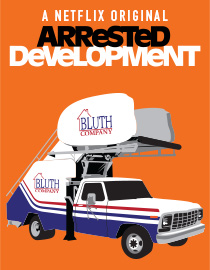
TV Talk: ARRESTED DEVELOPMENT, The Netflix Season

Posted on 05:00 by Guy
Despite being told for years that we really needed to watch Arrested Development, and even being given the first season of the show on DVD as a Christmas gift one year, we didn't take the bait until about a year ago--six years after its last episode aired. We never did get around to those DVDs, but my stepdaughter Kate shepherded us through the full run of the series on Netflix. Although this show lacks most of the characteristics that render something conventionally "lovable," we soon joined its deeply devoted, although never large, following, and loved it anyway. That following had been clamoring for a continuation of the story of the Bluth family almost since the day Arrested Development was cancelled; by the time we started watching, the plans for a long-delayed "fourth season" were already in the works.

ARRESTED DEVELOPMENT, Season 4, via Netflix.com
All 15 of these new episodes were added to Netflix on Memorial Day weekend. Some fans watched them all straight through in one extended binge, some spread them over a few days, and some watched because they had to. Some watched the first few episodes, and then quit; some aren't sure they're even fans any more.

We watched all the episodes at the rate of two or three at a time over the course of about a week, and having stayed to the end, I understand why some people bailed before the halfway point. I'd suggest you pick it back up, though. The individual episodes get better, for one thing: but more importantly, a good deal of what's introduced early on comes back in later episodes--and with a better-established framework, it's a lot funnier when it does.

That makes sense, since one hallmark of Arrested Development's style of comedy was its callbacks and running gags. They're still there, but it takes a little more patience to get to them, largely because of the way this "season" is constructed. A major reason that it took so long for this followup to happen at all was the difficulty of reassembling the show's cast, which forced a different approach to storytelling. The storylines don't move forward in a smooth linear fashion, and there are only a very few scenes that include all of the original characters together; rather, each episode focuses on one Bluth (or Funke, if you count in Tobias and Maeby), joined by just one or two other family members and some new characters.

There are definitely weaknesses at the episodic level. Nearly every individual episode is longer than it should be for optimal comedy--32 to 37 minutes straight through, without commercials (although there are fake "act breaks" where they would go), is a little more of these people than we need in a single dose. Not having all of the core characters in every episode changes the chemistry from the original recipe, and not usually for the better. As I said earlier, this isn't a conventionally lovable sitcom, and it features some of the most fundamentally unlikable characters this side of Seinfeld--Season 4's structure reinforces just how unpleasant these people really can be.

All that said, AD's Netflix season is best considered as a whole rather than in parts. It's essentially founded on just a few events which are frequently revisited from different characters' perspectives, and that structure means that it makes more sense as a single work. While that single work is absorbed more easily a couple of pieces at a time, it's not really possible--or fair--to see it it that way if you don't see all of the pieces.

I'm glad I did. I might, eventually, do it again, and if you loved
AD's original three seasons, I recommend the Netflix season in full. And if you find it a not-completely-worthy followup, might I suggest giving its genuine spiritual successor, Archer, a try? Sterling Archer and Buster Bluth have the same mother. (And Archer's also available for catching up on Netflix.)


Posted with BlogsyPosted with Blogsy
Read More
Posted in pop culture: TV, randomness, reviews | No comments

miercuri, 20 februarie 2013

Wordless Wednesday: The Oscar Goes To...

Posted on 05:00 by Guy
TARDIS Cosplayers at Gallifrey One (photo by Paul Vasquez) www.3rsblog.com

...for "Best Interpretation of a Time- and Space-Traveling Object":
The TARDIS Girls (and a Couple of Guys) of Gallifrey One, 2013

Credits:
Original photo by Paul Vasquez (edited with Snapseed, text added with Phonto)
TARDIS pinafore* by Amanda Marin/Darling Army
TARDIS-printed waist-cincher corset* by Yuly Springer/Butterfly Frillies

Linked-Up Wordless Wednesday has two new players this week, and our theme is inspired by this weekend's Academy Awards ceremony. Please check out "The Oscars" bestowed by
Desiree Eaglin
Catalina Juarez
Candice Kahn
Susanna Morgan
Kim Tracy Prince

(I think I'm getting the award for "Nerdiest Participant in Linked-Up Wordless Wednesday" this week.)

*Disclosure: All cosplay items were purchased, but I wanted to identify their sources.


Posted with BlogsyPosted with Blogsy
Enhanced by Zemanta
Read More
Posted in fotos, nerd factor, pop culture: TV, Wordless Wednesday | No comments

joi, 24 ianuarie 2013

Book Talk: THE REVOLUTION WAS TELEVISED, by Alan Sepinwall

Posted on 05:00 by Guy
cover image: THE REVOLUTION WAS TELEVISED, via www.alansepinwall.com
The Revolution Was Televised: The Crooks, Cops, Slingers and Slayers Who Changed TV Drama Forever
Alan Sepinwall (Blog) (Twitter)
Self-published by What's Alan Watching? (November 2012), trade paper (ISBN 0615718299 / 9780615718293)
Nonfiction: essays/pop culture, 306 pages
Source: Purchased ebook (Smashwords: ISBN 9781301879960)
Reason for reading: Personal; recommended by Linda Holmes of Pop Culture Happy Hour

Excerpt from an Excerpt (previously published on Grantland.com):
“The story of Lost makes no sense.

And by that I don't mean the story on the show — though this is the point where you can feel free to insert jokes about the numbers, the outrigger shootout, or the reasons why Walt was "special" — but the story of how Lost itself got made.

The creation of Lost defies nearly everything we know about how successful television shows — or great ones — are made. The idea for Lost came not from a writer, but a network executive. The first writer on the project got fired. The replacement creative team had a fraction of the usual time to write, cast, and produce a pilot episode. The executive who had championed the show was himself fired before it ever aired. One of the two creators all but quit the moment the pilot was finished. Nearly every creative decision at the start of the show was made under the assumption that it would never succeed. Everyone believed it was too weird, too dense, too unusual to work. And it may have been. But it worked, anyway.”
Book description: A mob boss in therapy. An experimental, violent prison unit. The death of an American city, as seen through a complex police investigation. A lawless frontier town trying to talk its way into the United States. A corrupt cop who rules his precinct like a warlord. The survivors of a plane crash trying to make sense of their disturbing new island home. A high school girl by day, monster fighter by night. A spy who never sleeps. A space odyssey inspired by 9/11. An embattled high school football coach. A polished ad exec with a secret. A chemistry teacher turned drug lord. 
These are the subjects of 12 shows that started a revolution in TV drama: The Sopranos. Oz. The Wire. Deadwood. The Shield. Lost. Buffy the Vampire Slayer. 24. Battlestar Galactica. Friday Night Lights. Mad Men. Breaking Bad. 
These 12 shows, and the many more they made possible, ushered in a new golden age of television — one that made people take the medium more seriously than ever before. Alan Sepinwall became a TV critic right before this creative revolution began, was there to chronicle this incredible moment in pop culture history, and along the way “changed the nature of television criticism,” according to Slate. The Revolution Was Televised is the story of these 12 shows, as told by Sepinwall and the people who made them, including David Chase, David Simon, David Milch, Damon Lindelof and Carlton Cuse, Vince Gilligan and more.
Comments: I don’t often blog about television, because unless I want to get into the recapping business--and I don’t--I find it difficult to capture thoughts on such time-sensitive things as TV-show episodes. But many of my favorite blogs to read--other than book blogs, of course--and podcasts to listen to are either partly or exclusively TV-related, and the best of them manage to find ways to combine timely recapping with more analytical discussions of series arcs, themes, and characters.

Thought-provoking, insightful commentary on movies has been around for decades, but there’s less history of it with television. However, both television drama and the internet have pushed boundaries during the last 15 years or so, and it seems fitting that thought-provoking, insightful commentary on thought-provoking, insightful television would spring up online. TV critic Alan Sepinwall has been a leading source of this commentary, at his popular blog, What’s Alan Watching?, and on his long-running podcast with fellow Hitfix.com writer Dan Fienberg. Drawing on years of background material as well as new interviews, Sepinwall discusses twelve of the most groundbreaking, influential television dramas of recent times in The Revolution Was Televised: The Crooks, Cops, Slingers and Slayers Who Changed TV Drama Forever.

The “crooks” and “cops” Sepinwall’s subtitle alludes to are from series like Oz, The Sopranos, The Wire, The Shield, and Breaking Bad; the “slingers” would be the foul-mouthed Wild West denizens of Deadwood; and, of course, the “slayer” is one Buffy Summers. The book’s thesis, supported by Sepinwall’s examples, reflects the influence and depth of genre conventions in storytelling--in addition to the shows referenced in the subtitle, we have 24, Battlestar Galactica, and Lost--and their expansion well beyond any limits of genre, illustrated via Friday Night Lights and Mad Men. While much of the resource material for the book comes from Sepinwall’s columns and blog, The Revolution Was Televised is by no means a collection of recycled posts. This is deep-diving, detailed discussion of how great television gets made. Sepinwall gets into the production and behind-the-scenes business of each show as well as the analysis of significant episodes and characters. This is writing that takes television as serious art seriously, and if you’re interested in that kind of thing--and granted, I very much am--it’s all thoroughly engaging, engrossing reading. It left me wanting to read more about, and re-watch with new perspective, the shows I love, and got me much more interested in catching up on some of the shows I’ve never watched.

The Revolution Was Televised is also notable for reasons other than its content. Sepinwall opted to self-publish it, but it has since been acquired by one of the publishers who turned down his original book proposal and will be reissued by Simon and Schuster’s Touchstone imprint this coming spring. And while traditional-publisher reprints of self-published works are becoming more common, reviews of self-published works in traditional critical venues are still pretty rare; Sepinwall’s book not only scored a New York Times review, it ended up on NYT book critic Michiko Kakutani’s top-10 list for 2012. I know it’s only January, but I won’t be surprised if The Revolution Was Televised ends up on my own 2013 Books of the Year list, too.

Rating: 4/5


Read More
Posted in Ebook Reading Challenge, nonfiction, pop culture: TV, reading, reviews | No comments

joi, 19 aprilie 2012

The Show Goes On: the Warner Bros. Studio Tour (Part 2)

Posted on 05:00 by Guy
When we last saw our tour group at the Warner Bros. Studios VIP Tour, we were on our way out of the "Midwest" and about to visit a working soundstage, which is where most interior filming happens. Some of that does get done on the back lot too, though.

Warner Bros. studio tour facade setWarner Bros. Studios "practical" set
These are two different kinds of interior sets used on the back lot. The one on the left is a "facade," and on film you'd see it from the opposite direction (characters would be standing on a small platform just inside the doorway, with outdoor activity visible through the door or window behind them). The set on the right is a "practical" interior which might be used instead of a soundstage.

Warner Bros. Studios--last set left from CASABLANCA
You must remember this...although you probably remember it differently. This is the last remaining exterior set used in Casablanca.

Warner Bros. Studios Stage 16, world's tallest soundstage
This is Stage 16, the world's tallest soundstage--98 feet high, with a dropped floor. It's been used for filming many water sequences, including some of those in Titanic.

The tour doesn't allow photography inside the soundstages (in fact, you'll have to let the guide lock up your cameras and phones in the golf cart before you go inside). Therefore, I have no photo evidence to prove that we visited Soundstage 25, which has been in steady use since the 1930's for movies, and later for television. Parts of Casablanca were filmed in there, and it's currently where The Big Bang Theory rehearses and tapes. The show has Saturdays off so we didn't get to watch anything, but our guide Kacey gave us a nice rundown of the process...and we did catch a glimpse of the set for Howard and Bernadette's upcoming wedding!

Batmobile Tumbler, from The Dark KnightPaul & the Batmobile
The Batmobile Tumbler will soon be coming from Gotham City in The Dark Knight Rises, but it was on the Warner Bros. lot the day we visited. It's one of Tall Paul's all-time favorite vehicles, and as he said when he posted its picture on his Facebook page, it "looks as bad-ass in person as it does in the movies."

Warner Bros. Studios car museum: Ford Anglia from HARRY POTTER
The studio's car museum contains a few iconic vehicles (and some that just wish they were), but my favorite was Mr. Weasley's car, seen after it lost the fight with the Whomping Willow. The Harry Potter movies weren't filmed at the Burbank studio--at J.K. Rowling's behest, they were made in the U.K.--but they're the subject of a special exhibit at the main museum. (That was another spot that didn't allow photography, but it features many props and costumes, including the Sorting Hat!)
Warner Bros. Studios: FRIENDS set
Friends' Central Perk set remains as a mini-museum of its own.

Warner Bros. Studios "New York" back lot sets
These sets from "New York" street, like the "Chicago" back lot in yesterday's post, may double for other cities. The "theater" on the left (without the "subway entrance" visible in front) recently represented its hometown of "Hollywood" in The Artist.


Warner Bros. Studios "New York" back lot "bookstore" facade
Hey, they still have bookstores in the movies!


The Warner Bros. VIP Studio Tour operates on weekdays and Saturdays, and advance reservations are recommended. Tickets are $49 per person, and children under age 8 are not allowed. The tour lasts 2.5 hours via golf cart and on foot, and the content will vary as production schedules affect access to sets and stages.

If you have any interest in what really happens behind the scenes and what "Hollywood's" work environment really looks like, I highly recommend this tour, and I'd take it again.

Disclosure: My husband and I purchased our own tickets for the Warner Bros. VIP Studio Tour at a slight discount from a "perks" program offered through my employer. 
Read More
Posted in 'riting, mostly true stories, pop culture: movies, pop culture: TV, So Cal, travel | No comments
Postări mai vechi Pagina de pornire
Abonați-vă la: Postări (Atom)

Popular Posts

  • Book Talk: *The Forgetting Tree*, by Tatjana Soli (TLC Book Tour)
    The Forgetting Tree: A Novel Tatjana Soli St. Martin's Press (September 2012), Hardcover (ISBN 1250001048 / 9781250001047) Fiction, 416 ...
  • The BlogHer14 Highlight Reel, Part 1
    I was at a big convention-type gathering this past weekend...and it wasn't San Diego Comic-Con. I attended my third BlogHer Conference ,...
  • (BlogHer) Book (Club) Talk: *The Fault in Our Stars*, by John Green
    The Fault in Our Star s John Green ( Twitter ) ( Facebook ) Dutton Juvenile (2012), Hardcover (ISBN 9781101569184 / 1101569182) Fiction (YA...
  • On Book Blogging: Really, Positively Enthusiastic
    I think that when most of us can freely choose what to read--when there’s no obligation or assignment--we’re usually going to pick books we ...
  • Book Talk: THE STORIED LIFE OF A.J. FIKRY, by Gabrielle Zevin
    The Storied Life of A. J. Fikry: A Novel Gabrielle Zevin   (Twitter)   (Facebook) Algonquin Books (April 2014), Hardcover (ISBN 1616203218 /...
  • WW: Shelved!
    We've got a "wild card" week in our Wordless Wednesday linky group , so I thought you might like to see what we did with our d...
  • On Book Blogging: An Authentic Opinion is Priceless
    Today's BBAW topic is a deceptively simple question : “What does book blogging mean to you?” Short answer: Book blogging means thought...
  • Featured at Book Bloggers International: Me!
    Today's one of those days when I invite you to see what I'm doing somewhere else! So, what is Book Bloggers International exactly a...
  • Always Have a Backup Plan: a "Learning Experience"
    There are so many things I like about blogging, but one that I don't talk about all that often is the technical side. Maintaining a blog...
  • Sunday Salon on Monday: Various Updates Without a Clever Subtitle
    I'm writing this post on Sunday, so technically it's not late, but it's not posting until Monday because, as of right now, I...

Categories

  • 'riting
  • #BBBSys
  • #DailyBookPic
  • #GenFab
  • #JustOneParagraph
  • #JustOneParagrpah
  • #photoaday
  • #readchabon
  • 24-Hour Readathon
  • a bunch of books
  • announcements
  • Armchair BEA
  • ArmchairBEA
  • Audiobook Challenge
  • audiobooks
  • Banned Books Week
  • BBAW
  • BEA12
  • BEA2014
  • blog tour
  • Bloggiesta
  • Bloggiesta2012
  • BlogHer
  • BlogHer Book Club
  • blogs elsewhere
  • book bloggers
  • Bookkeeping
  • books and authors
  • CA12
  • CBSLA Best of LA
  • contests and giveaways
  • E-Book Reading Challenge
  • Ebook Reading Challenge
  • ebooks
  • family
  • fiction
  • food
  • fotos
  • Friday Foto
  • guest post
  • holidays
  • indie authors
  • Indie Lit Awards
  • JustOneParagraph
  • links
  • Memorable Memoirs Reading Challenge
  • metabloggery
  • mostly true stories
  • NaBloPoMo
  • nerd factor
  • news traffic and weather
  • nonfiction
  • pop culture: movies
  • pop culture: music
  • pop culture: TV
  • randomess
  • randomness
  • reading
  • retrospective
  • reviews
  • roundup
  • ShelfAwareness
  • SheReads Book Club
  • So Cal
  • SoCal
  • Sunday Salon
  • SYJ Book Awards
  • TellAStory Thuesday
  • thinking out loud
  • Thoughts From My Reading
  • Throwback Thursday
  • travel
  • Weekend Cooking
  • Weekend Review
  • Wordless Wednesday
  • work

Blog Archive

  • ▼  2014 (114)
    • ▼  iulie (16)
      • The BlogHer14 Highlight Reel, Part 1
      • Book Talk: THE STORIED LIFE OF A.J. FIKRY, by Gabr...
      • "I should be folding laundry..."
      • Book Talk: ARTS & ENTERTAINMENTS, by Christopher B...
      • What's What in the Sunday Salon, July 20, 2014
      • Shaking the (Blogging) Family Tree--Throwback Thur...
      • Wordless Wednesday: Blue
      • Book Talk: GOLDEN STATE, by Michelle Richmond
      • What's What: July 13 (Sunday Salon)
      • The Empty Spaces: Picturing A Life Without Bloggin...
      • Celebrating 3 Decades of Chris (Not-Quite-Wordless...
      • Book Talk: BRUTAL YOUTH, by Anthony Breznican
      • What's What (Sunday Salon): Mid-2014 Bookkeeping G...
      • Book Talk: THE POSSIBILITIES, by Kaui Hart Hemmings
      • Big Bang BOOM! (Wordless Wednesday)
      • (Audio)Book Talk: SELF-INFLICTED WOUNDS, by Aisha ...
    • ►  iunie (16)
    • ►  mai (15)
    • ►  aprilie (17)
    • ►  martie (18)
    • ►  februarie (13)
    • ►  ianuarie (19)
  • ►  2013 (201)
    • ►  decembrie (14)
    • ►  noiembrie (16)
    • ►  octombrie (19)
    • ►  septembrie (17)
    • ►  august (19)
    • ►  iulie (23)
    • ►  iunie (16)
    • ►  mai (17)
    • ►  aprilie (16)
    • ►  martie (13)
    • ►  februarie (14)
    • ►  ianuarie (17)
  • ►  2012 (185)
    • ►  decembrie (14)
    • ►  noiembrie (15)
    • ►  octombrie (18)
    • ►  septembrie (14)
    • ►  august (14)
    • ►  iulie (16)
    • ►  iunie (16)
    • ►  mai (15)
    • ►  aprilie (20)
    • ►  martie (31)
    • ►  februarie (12)
Un produs Blogger.

Despre mine

Guy
Vizualizați profilul meu complet